
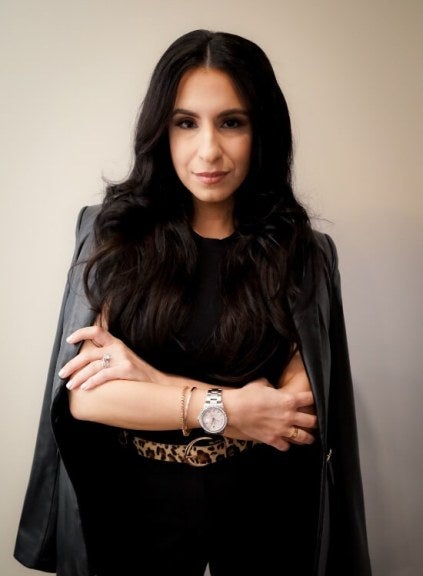


Program: MPS in Fashion Merchandising & Retail Management
Current Role: Director of Trade Marketing, L’Oreal
After starting her career in retail apparel store management, Amanda leveraged her skills, experience—and a master’s degree from LIM College—to transition into the beauty marketing space. Amanda now leads L’Oreal’s trade marketing strategy for the YSL, Prada, and Miu Miu Beauty brands, overseeing business across Sephora and Ulta. She describes this role as being rooted in “translating high-level brand vision into retail reality … bridging the gap between brand identity and the shopper journey.”
What was your first role after graduating from college, and how did it set the stage for your career trajectory?
While completing my degree, I worked full-time as a Visual Merchandising and Assistant Sales Manager at bebe. Graduating in 2013 into a hyper-competitive, post-recession market, I made the strategic decision to lean into my retail roots. I became an opening Store Manager for Windsor. That role was pivotal. It gave me direct exposure to the buying office and assortment planning, teaching me early on how consumer behavior on the floor dictates corporate strategy.
You earned a master’s degree in Fashion Merchandising & Retail Management from LIM College in 2017. What prompted you to do that?
I always knew I wanted a master’s degree, but I waited until I was a few years into my fashion career to ensure my focus was intentional. I chose to complete my master’s at LIM College because it sits at the intersection of my two passions, analytical rigor and visual storytelling. While I had a natural talent for "digging into the numbers," I also loved the psychology of the consumer journey. LIM provided the framework to marry data-driven patterns with the art of brand experience.
How did you arrive at the decision to transition from apparel into beauty?
After a decade in fashion, I was ready for a new challenge. While I am a passionate admirer of both industries, the beauty market was, and is, booming with innovation. When the opportunity arose to join YSL at L’Oréal, it felt like a full circle moment. I could bring my fashion sensibilities to the fast-paced, high-growth world of beauty.
How have you seen the beauty industry evolve since you started working in it?
The landscape has shifted from selling a product to providing a service. We’ve seen a massive digital transformation with AI and augmented reality, such as L’Oréal’s digital shade-finders and skin-diagnostic tools. The consumer is also more educated than ever. They aren't just looking at the brand name. They are also scrutinizing the ingredients and are thoughtful about the products they purchase.
What skills have proven most essential in your success?
My analytical skills, business acumen, and ability to build concise operational workflows have been the pillars of my technical success. However, the qualities that have truly propelled my growth are adaptability and a willingness to learn. Being able to effectively manage change has allowed me to navigate and thrive across different business categories, industries, and market landscapes. I also believe that strong communication, mutual respect, and a collaborative mindset are the non-negotiables that have helped me—and my teams—consistently win.
How do you think the industry will change in the next five years?
I expect a total convergence of skincare and color. We are moving toward "beauty with benefits" where the expectation is that every cosmetic product improves the skin’s health. Aesthetically, I think we will see a move toward sharp maximalism. Just as fashion is trending toward structured, bold silhouettes, beauty will likely follow with high-pigment, intentional looks that move away from the "no-makeup" makeup of the last few years. Technologically, I believe AI will move from novelty to an essential utility in every step of the retail experience.
What advice would you give someone trying to build a career beauty marketing?
Keep your finger on the pulse of the world, not just the industry. Be conscious of the economic landscape, have a definitive point of view, and never be afraid to be the voice in the room. Most importantly, stay obsessed with the consumer—if you understand their needs and passions, the marketing strategy will follow naturally.